
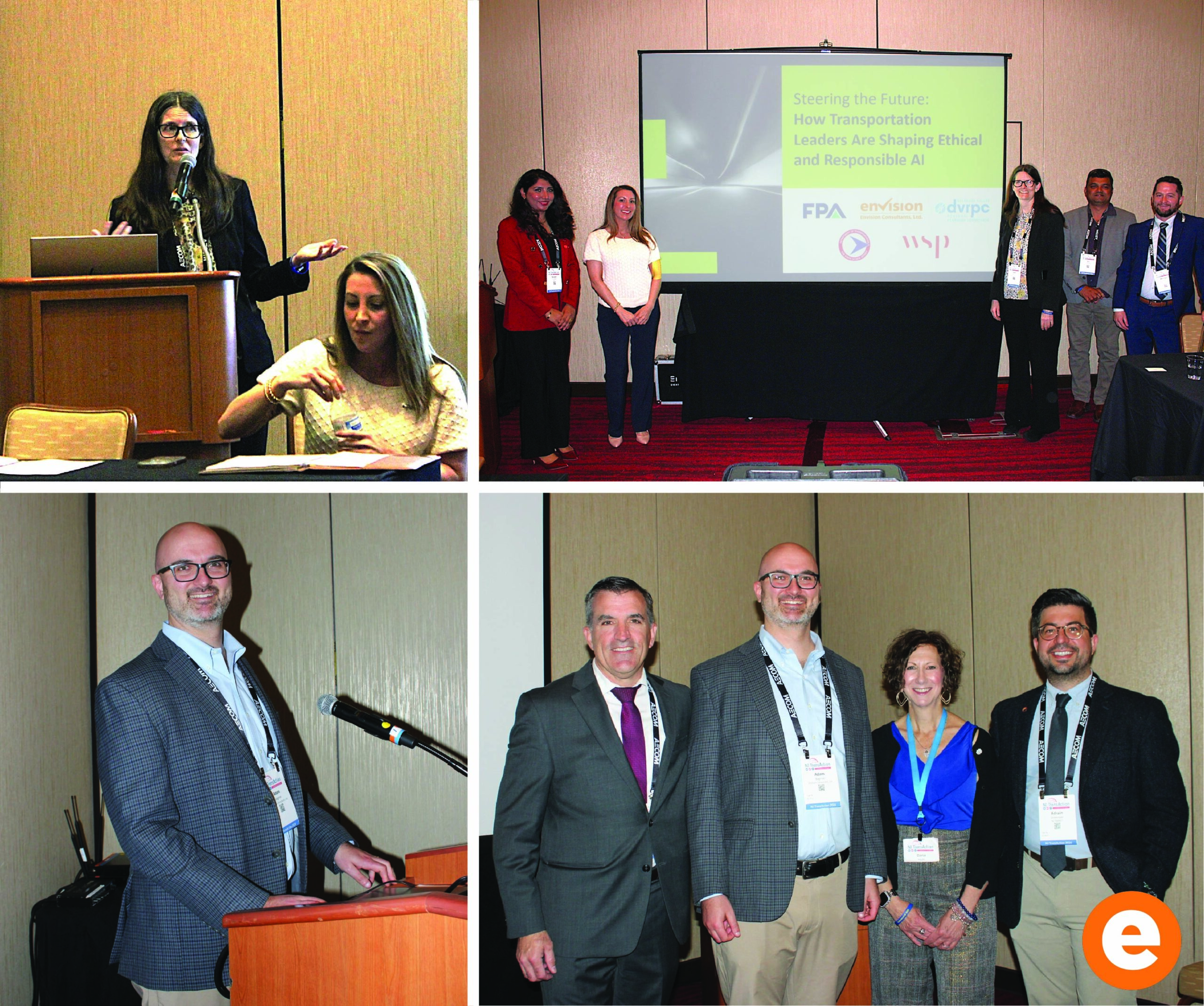
April 30, 2026 – The transportation industry across New Jersey and the greater Northeast Corridor continues to evolve as agencies respond to aging infrastructure, major capital investment programs, workforce transitions, and emerging technologies. These shifts are driving new conversations about how transportation systems are planned, delivered, and sustained over time.
Envision Consultants, Ltd. (Envision) participated in these discussions at the NJ TransAction Conference in Atlantic City, where firm leaders contributed to sessions focused on two critical issues facing the industry today: preserving institutional knowledge and responsibly integrating artificial intelligence (AI) into transportation practice.
Adam Baginski, PE, PMP, Envision’s Vice President of Rail and Transit Services, addressed the growing workforce transition challenge often referred to as the “experience cliff.” As seasoned professionals retire and emerging professionals move into leadership roles, agencies and consulting firms are working to retain institutional knowledge and sustain long-term programs.
With experience across rail engineering, operations, and program management, Baginski has worked on major capital programs requiring sustained coordination and oversight. This perspective shaped his discussion on preserving institutional knowledge and improving continuity across project lifecycles.
Baginski discussed deliberate approaches to retaining organizational knowledge, including documenting lessons learned, capturing operational context, and ensuring critical program history is carried forward as teams evolve.
His remarks emphasized that effective knowledge transfer is essential to maintaining safety, performance, and informed decision-making on complex, multi-year transportation initiatives. By embedding experience into processes and teams, organizations can reduce risk and maintain consistent delivery even as the workforce changes.
The conference also featured a discussion on the responsible integration of artificial intelligence (AI) in transportation. Drawing on a background that combines transportation engineering with workforce and organizational leadership, Envision’s Director of Engineering Services, Carol Martsolf, PE, PMP, CPTD, ENV SP, LEED AP, approaches AI through the lens of ethics, professional judgment, and human oversight.
In her presentation, Martsolf emphasized a clear, human-centered approach to the use of AI. She noted that AI can support decision-making, but engineers must remain accountable for the results.
Martsolf also discussed how agencies are beginning to incorporate AI into planning, project delivery, and operations. She emphasized governance, oversight, and professional accountability, and noted the importance of transparency and alignment with engineering standards.
Together, Baginski’s and Martsolf’s presentations reflected broader industry conversations around workforce transition, leadership continuity, and the careful application of innovation. As transportation organizations adapt to changing conditions, sustained progress will depend on preserving institutional experience while integrating new technologies responsibly.