
November 3, 2026 – SEPTA’s 2026 Project Cost Estimating Guidelines significantly expand the documentation, transparency, and project controls requirements associated with estimate development. While these changes may appear to increase effort for project teams, Envision has already implemented the processes and tools required to support compliance with the new standards.
The updated requirements place greater emphasis on estimate transparency, line-item detail, production-based cost development, risk evaluation, schedule integration, and quality assurance. For Envision, these changes do not represent a new direction. In fact, they formalize many of the estimating practices we have already implemented in preparation for this update. Read further to learn more about the steps we’ve taken to prepare for SEPTA’s updated estimating guidelines.
Building the Foundation Before the Requirements Changed
Transportation agencies across the country have steadily increased expectations for estimate accuracy, transparency, and accountability. Recognizing these trends, Envision has continued to strengthen its estimating capabilities through investments in people, processes, and technology. As a result, many of the requirements contained in SEPTA’s 2026 Project Cost Estimating Guidelines align closely with practices that Envision has already been incorporating into our standard approach.
Several areas of focus have shaped our preparation:
- Expanded Basis of Estimate & Basis of Scheduling documentation
- Increased integration between estimating and scheduling
- Continued buildout of robust supporting documentation (flat files, vendor quotes, equipment basis)
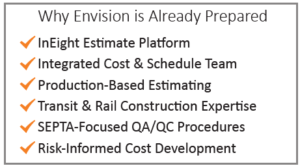
Envision has also invested in InEight Estimate software, the same platform utilized by SEPTA’s (and Amtrak’s) internal cost engineering staff. Having the right software platform is a key component in consistent estimate quality, and our InEight framework seamlessly integrates with SEPTA’s, supporting transparency and consistency during estimate development and review. When requested, estimate supporting documentation can easily be shared with SEPTA for download into their InEight program for review. Envision is already able to provide all of this as part of our existing estimating service line, at no additional cost or effort for owners or design teams.
Transparency That Goes Beyond the Bottom Line
One of the most significant themes throughout SEPTA’s 2026 Project Cost Estimating Guidelines is the increased emphasis on estimate transparency. SEPTA is seeking a high level of visibility into how project costs are developed, what assumptions are being made, and which factors may influence project budgets as designs advance.
We have long viewed estimate documentation as a critical component of quality cost engineering. Our estimates are supported by detailed line item and assembly breakdowns, along with narratives that explain project scope, assumptions, methodologies, and risks. This allows owners and project teams to better understand the basis of each estimate and key cost drivers.
Some of the key changes emphasized by SEPTA in the 2026 Project Cost Estimating Guidelines include:
- Expanded Basis of Estimate requirements
- Second Level CSI Division reporting
- Enhanced documentation of assumptions and exclusions
- Increased estimate traceability between design milestones
These changes drive transparency which improves decision making and provides stakeholders with a clear understanding of how project budgets evolve throughout design. In addition, they provide a new, higher level of clarity during procurement phase and bid analysis, especially useful within a multi-prime environment. Envision’s established InEight second level CSI division and multi-prime breakout templates are already prepared to meet SEPTA’s new requirements without any additional coordination from our project partners or design teams.
Estimating from a Construction Perspective
SEPTA’s updated guidance places greater emphasis on production-based estimating and project-specific construction considerations. The goal is to develop estimates that more accurately reflect actual construction conditions rather than relying solely on historical pricing data.
Our estimating practice has always approached estimating from the perspective of how work will be built, whether by a contractor or SEPTA Force Account. By considering labor, equipment, access constraints, staging requirements, and operational impacts during estimate development, we provide project teams with a clear understanding of the factors driving construction costs.
Although we have always included the following information in the development of our estimates, you can expect to see increased clarity and additional detail in SEPTA submissions going forward.
- Production based cost development
- Labor productivity and crew-based estimating
- Project specific means and methods assumptions
As always, Envision’s construction and transit-focused approach will continue to deliver estimates that are technically sound and grounded in real world execution from a ‘boots on the ground’ perspective.
Connecting Cost and Schedule
The 2026 SEPTA Cost Estimating Guidelines reinforce the relationship between project schedule and project cost. Construction durations, phasing plans, procurement lead times, outages, and operational constraints all influence project budgets and must be considered together.
To support this objective, Envision maintains close coordination between our estimating and scheduling professionals. This integrated approach improves consistency across project controls deliverables and helps identify potential cost impacts early in the design process.
SEPTA’s updated requirements place greater emphasis on:
- Schedule driven cost evaluation
- Construction phasing validation
- Coordination between estimating and project controls
Envision can be counted on to deliver estimates based on realistic experience-based phasing and construction sequencing, even in the early phases of design. By evaluating schedule and cost together, and combining our project controls expertise with our rail and transit expertise, our project team partners are better positioned to understand project execution requirements and make informed planning decisions.
Understanding and Managing Risk
The updated 2026 SEPTA Project Cost Estimating Guidelines introduce a more structured approach to identifying and documenting uncertainty within project estimates. Reliable cost development requires an understanding of the risks that may influence project delivery, cost growth, and schedule performance.
Envision incorporates risk evaluation throughout the estimating process, helping owners and project teams understand the factors that may affect project outcomes and contingency requirements.
Key areas of emphasis include:
- Formal risk identification and assessment
- Risk informed contingency development
- Documentation of project specific cost drivers
Through our transit-focused experience, we continue to incorporate risk analysis into estimate development, giving project stakeholders greater insight into potential budget pressures before they affect project delivery.
Quality Built into the Process
As SEPTA increases expectations for estimate transparency and accountability, quality assurance becomes increasingly important. Estimates must be accurate to bid conditions, and be able to withstand detailed review by owners, project managers, independent estimators, and funding stakeholders.
Envision maintains a structured quality review process designed to validate estimate accuracy, consistency, and completeness before submission. This process, which has been developed with SEPTA’s needs in mind, is robust, transparent, and available for review by owners and our project partners.
The 2026 SEPTA Project Cost Estimating Guidelines place increased emphasis on:
- Independent estimate reviews
- Estimate reconciliation and validation
- Documented QA/QC procedure
Envision continues to capitalize on these reviews to ensure that estimates are well supported, defensible, and aligned with SEPTA’s expectations.
What This Means for Design Teams
SEPTA’s updated requirements will increase the level of effort associated with estimate preparation, documentation, and milestone submissions. Activities that were previously informal are now required and documented deliverables. For many design teams, this may result in additional coordination, more detailed estimate reviews, increased documentation requirements, and greater scrutiny of project assumptions.
At Envision, we continually anticipate the evolving needs of owners and our project partners. We have already taken the necessary steps to absorb as much of this effort as possible on behalf of our project partners. Our established estimating workflows, documentation templates, and controls processes are directly structured in a way that meets these requirements, helping design teams maintain compliance without creating unnecessary burden on technical staff.
Ready to Help Project Teams Navigate SEPTA’s New Requirements
SEPTA’s 2026 Cost Estimating Guidelines represent a meaningful evolution in how project costs are developed, documented, and reviewed and create an opportunity for project teams to improve cost certainty, transparency, and decision-making.
Envision has already invested in the tools, processes, and staff expertise necessary to meet these expectations. Our goal is not simply to prepare compliant estimates, but to help our project partners navigate the new requirements efficiently while providing a seamless estimating experience throughout project delivery. Whether supporting proposal development, preliminary engineering, final design, independent estimate reconciliation, or bid phase services, Envision is prepared to help project teams meet SEPTA’s new requirements efficiently and confidently.
To learn more about our approach or discuss how Envision can support your next project, please reach out to Thomas Dutcher, Director of Cost Estimating.

Envision Consultants, Ltd.
1600 John F. Kennedy Boulevard
Suite 620
Philadelphia, PA 19103
267.639.6185 ext. 313
tomdutcher@eclimited.com